
Retaining Wall Inspection in Reno: What to Check This Spring
Most conversations about lawn care and landscaping focus on what you can see growing. But there is a category of damage happening right now in Reno, NV that has nothing to do with grass or plants. It is structural, it is gradual, and it is easy to miss until it becomes a serious problem. The retaining walls we build and repair in Reno take a hit each winter, and April is the month when that damage is most visible and most fixable. The freeze-thaw cycles that hit the Truckee Meadows area between November and March, the same kind of winter pattern Ready.gov highlights in its winter weather guidance, do more to destabilize retaining walls than almost any other force, and right now, the ground is soft enough to work with but not yet baked hard by July heat. That window matters more than most people realize.
What Reno’s Winter Actually Does to Retaining Walls
The high desert climate around Reno creates a specific kind of stress on hardscape structures. Water gets into small gaps in mortar, block joints, or behind the wall itself. It freezes, expands, and pushes. Then it thaws and contracts. Repeat that cycle 30 or 40 times between November and March, and what started as a hairline crack becomes a structural concern. Neighborhoods like South Meadows and Damonte Ranch, where graded lots and retaining walls are common on sloped properties, see this pattern every year.
What makes this especially relevant right now is that the soil behind your wall has been holding excess moisture from snowmelt and spring rain. That moisture creates hydrostatic pressure, which is the force of water-saturated soil pushing against the back face of your wall. The Federal Highway Administration’s retaining wall guidance treats drainage as a structural requirement for exactly this reason. If your drainage system is compromised or was never properly installed, that pressure builds silently. You will not notice it until a section of wall starts to bow, lean, or crack along a horizontal line.
Our team has been out on properties across the Reno area this month and the pattern is consistent: walls that looked fine in October are showing stress now. Some of it is cosmetic. Some of it is not.
The Retaining Walls Reno Homeowners Should Inspect Right Now
You do not need a contractor to do a first-pass inspection. Walk your property and look for these specific warning signs:
First, check for horizontal cracking. A crack that runs parallel to the ground, especially in the middle third of the wall, is a sign of bending stress from soil pressure behind the structure. Vertical cracks are often less urgent, but horizontal ones deserve immediate attention.
Second, sight down the face of the wall from one end. Any bowing or bulging, even slight, means the wall is moving. Movement that has already started tends to accelerate, not stabilize on its own.
Third, look at the base. Soil that has washed away from the toe of the wall, or any visible gap between the wall base and the ground, suggests the footing has shifted.
Fourth, check your drainage. If you have weep holes in the wall, make sure they are clear. If you have no weep holes, that is a design issue worth addressing before next winter. Proper drainage is not optional on retaining walls in this climate.
If you find any of these issues, the time to act is now. We have written more about the long-term value of addressing these problems proactively in our post on how retaining walls protect and boost your property value, but the short version is this: a wall that fails takes the surrounding landscape with it, and that repair bill is always larger than the preventive one.
New Retaining Walls Reno Projects: Why April Scheduling Matters
If you have been thinking about adding a retaining wall to manage a sloped yard, create a usable flat area, or protect a hillside from erosion, April is the right time to get that project scheduled, not started. Our build calendar fills quickly once the weather stabilizes, and projects that get on the schedule now are the ones that get completed before summer entertaining season.
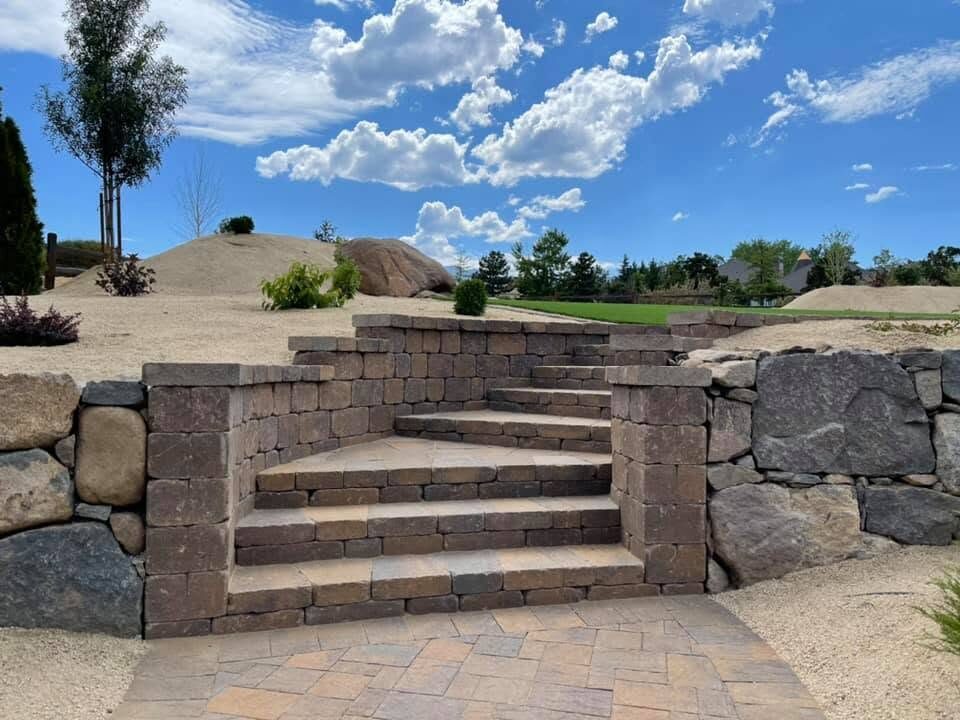
A well-designed retaining wall is also a foundation for other outdoor improvements. We regularly combine wall projects with paver patios and walkways, outdoor steps, and outdoor lighting to create cohesive outdoor spaces that work with the natural grade of the property rather than against it. Bundling these projects together is also more efficient from a labor and material standpoint, which is something worth considering if you have multiple improvements on your list.
For properties where the design scope is larger, our 2D and 3D design and rendering service lets you see the finished project before a single block is moved. That step alone tends to prevent costly changes mid-build.
The Cost of Waiting Until Summer
Here is what our team sees every July and August: homeowners who noticed wall movement in April, waited to call, and are now dealing with a failure rather than a repair. Dry summer soil pulls away from structures differently than moist spring soil, and walls that were borderline in April become actively unstable once the ground dries and contracts. Repair complexity goes up. In some cases, full reconstruction becomes necessary where a targeted repair would have been sufficient in spring.
If your property is in the Reno area, including surrounding communities we serve in Sparks and Carson City, this is the month to act on retaining wall issues in Reno you have been putting off. Our build slots for May and June are filling now, and once those are gone, the next availability pushes into late summer.
Reach out to our team through our contact page to schedule a site visit this month. If you wait until June to call, the honest answer is that we may not be able to get to your project until fall, and a wall that is actively moving does not benefit from waiting that long.