
Drip Irrigation in Reno, NV: Why High Desert Yards Need More Than a Standard Sprinkler System
A lot of homeowners in Reno, NV start searching for landscape help in spring because something stopped working over the winter. Maybe a shrub line dried out despite regular watering, or a new planting bed never really took hold. The underlying problem, more often than not, is a watering system that was never designed for this climate. Reno sits at roughly 4,500 feet in the high desert, and the combination of alkaline soil, low humidity, intense summer sun, and Truckee Meadows Water Authority watering guidelines means standard spray heads can waste more water than they deliver. That is why drip irrigation Reno searches spike every spring. Homeowners are not just looking for greener yards. They are looking for a system that actually works here.
What Makes Reno’s Soil and Climate Different From the Rest of the West
We work in yards across the region every week, from the newer subdivisions out near Double Diamond to the established properties along Plumas Street closer to the river corridor. The soil profile in most of Reno leans heavily toward caliche and compacted clay over sandy fill, depending on how much grading was done during original construction. Neither type absorbs water quickly. When a standard rotary or spray head dumps water at a rate faster than the soil can take it in, you get runoff, pooling, and evaporation rather than actual root saturation.
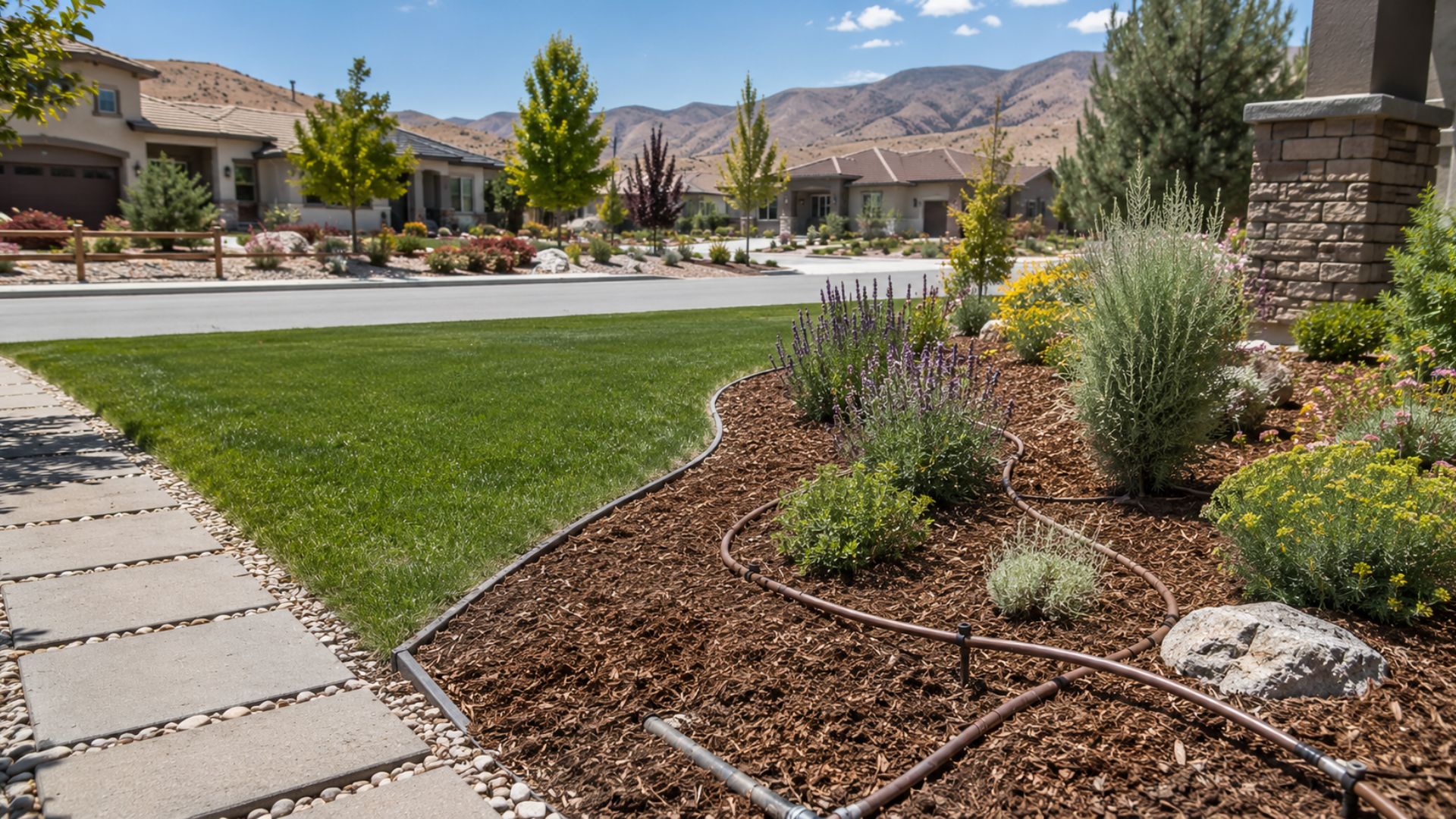
Add in the fact that May through August routinely brings afternoon temperatures above 90 degrees with relative humidity in the single digits, and surface evaporation becomes a serious issue. Water sprayed into the air in those conditions often never reaches the root zone at all. A properly designed drip system delivers water slowly and directly to the base of each plant, matching the soil’s absorption rate and cutting evaporation losses significantly. University of Nevada, Reno Extension guidance on tree and landscape irrigation makes the same practical point: root-zone watering, proper emitter placement, and soil-aware scheduling matter in Nevada’s dry climate. For anyone managing a mixed planting bed, a xeriscape border, or a row of ornamental trees, this is not a minor upgrade. It is the difference between a landscape that survives and one that actually thrives.
How We Design Drip Irrigation Reno Homeowners Can Actually Manage
One of the most common complaints we hear from homeowners who have tried drip before is that the system was too complicated to adjust or too fragile to maintain. Emitters clogged, lines got kinked, and nobody could figure out the controller. That usually comes down to a design problem, not a product problem.
Our irrigation installation process starts with a site assessment that maps out plant types, sun exposure, slope, and soil conditions across each zone. A rose bed in full western exposure near a stucco wall needs a different flow rate than a shaded native shrub border. We size emitters accordingly and run pressure-compensating lines so the system delivers consistent output whether a head is at the top of a slope or the bottom. For properties with significant grade changes, we often pair the irrigation design with retaining walls to manage runoff and keep water where the plants can actually use it.
We also set up controllers that connect to local weather data so the system adjusts automatically based on evapotranspiration rates. During a stretch of 95-degree days in July, the controller increases run times. After a rare summer thunderstorm rolls through from the Sierra, it skips the next cycle. Homeowners do not have to think about it, and the system stays aligned with TMWA seasonal watering expectations.
Drip Irrigation Reno Properties With Slopes, Rocks, and Mixed Landscapes
Reno is not a flat city. The foothills neighborhoods north of town, areas near Caughlin Ranch, and properties backing up to the Virginia Range all deal with sloped terrain that makes overhead irrigation nearly useless. Water runs off before it penetrates, and you end up with dry spots uphill and waterlogged areas at the base. Drip solves this by putting water at the root zone regardless of slope, and because flow rates are slow, the soil has time to absorb each cycle.
We also see a lot of mixed landscapes here, yards that combine ornamental plantings, native shrubs like rabbitbrush or sagebrush, and hardscape elements like paver patios and walkways. Each of those plant types has different water needs, and grouping them into the right zones is critical. Native plants in particular can be damaged by overwatering, especially once they are established. A well-zoned drip system lets you run your ornamentals on a full schedule while tapering back the natives to a maintenance level after their first season.
For homeowners who have already made the switch to artificial turf in their lawn areas, drip becomes the primary irrigation method for everything that remains, and getting those zones right matters even more. If you are planning a broader landscape refresh, our design and rendering process can map out the full picture before any installation begins, which helps avoid conflicts between irrigation lines, hardscape, and lighting conduit down the road.
Spring Is the Right Time to Assess and Install
May is when we start seeing the damage from last summer become obvious. Plants that looked marginal in September either did not make it through winter or are struggling to push new growth now. If your existing system ran all season and the results were still disappointing, the system design is worth a hard look before you repeat the same cycle.
Installing drip irrigation in Reno in spring also gives the system a full season to run before the hottest months arrive. New emitter placements can be adjusted before peak demand, and any pressure or coverage issues show up while there is still time to correct them without plant loss. We can also evaluate whether your current controller and backflow setup meets current TMWA requirements, which have tightened in recent years as water conservation has become a bigger priority across the Truckee Meadows.
Drip Irrigation FAQs for Reno Homeowners
Why is drip irrigation better than spray heads in Reno, NV?
Drip irrigation sends water slowly to the root zone instead of spraying it into dry air and wind. That matters in Reno because compacted soils, low humidity, and hot summer afternoons can turn overhead watering into runoff and evaporation.
Does drip irrigation work on sloped properties?
Yes. Sloped yards often benefit from drip because pressure-compensating emitters can deliver consistent water while slower flow rates give the soil time to absorb each cycle.
When should I install drip irrigation in Reno?
Spring is usually the best time. It gives the system a chance to run and be adjusted before peak summer heat puts new and existing plants under heavier stress.
If you are ready to stop guessing at why your landscape is not responding the way it should, reach out to our team and we can walk through what a proper drip system design would look like for your specific yard. The homeowners who get the most out of their landscapes here are the ones who stopped fighting the desert and started designing with it.
Reno’s water future is going to keep pushing toward efficiency. The yards that are already set up for it are easier to maintain and more resilient than the ones still running spray heads across compacted caliche in July.