
Outdoor Lighting Installation in Reno, NV: What to Expect
Our post on built-in fire pit installation covered why a heat source transforms a backyard in the evening hours, but it didn’t touch on what actually makes those evening hours usable in the first place: light. A fire pit creates ambiance in one spot. Outdoor lighting installation in Reno, NV does something structurally different. It extends the entire outdoor space, illuminating walkways, steps, seating areas, and architectural features so the yard functions after dark rather than going dark at sunset. In July, when Reno evenings stay warm well past 9 p.m. and the sun doesn’t set until nearly 8:30, that distinction matters more than most homeowners realize until they’ve lived through a summer without it.
Outdoor lighting installation in Reno, NV typically involves designing a low-voltage LED system, trenching wire runs to fixture locations, installing a transformer with a timer or photocell, and placing weatherproof fixtures along pathways, patios, steps, and focal points. A standard residential project takes one to two days to complete and uses fixtures rated for the temperature swings and UV exposure common in the high desert.
Key Takeaways
- Low-voltage LED systems are the standard for residential outdoor lighting in Reno because they handle the region’s heat, UV intensity, and wide temperature swings better than line-voltage alternatives.
- Reno’s high desert sun accelerates fixture degradation, so material selection, including brass, copper, and commercial-grade composite housings, directly affects how long a system lasts.
- Most residential outdoor lighting installations in Reno take one to two days, with transformer programming and final adjustments completed on the same visit.
- Lighting works best when it is planned alongside other hardscape elements like paver patios, outdoor steps, and retaining walls, not added as an afterthought.
- July is one of the highest-demand months for outdoor lighting in Reno because long summer evenings push homeowners to use their yards after dark for the first time.
What Outdoor Lighting Installation in Reno, NV Actually Involves
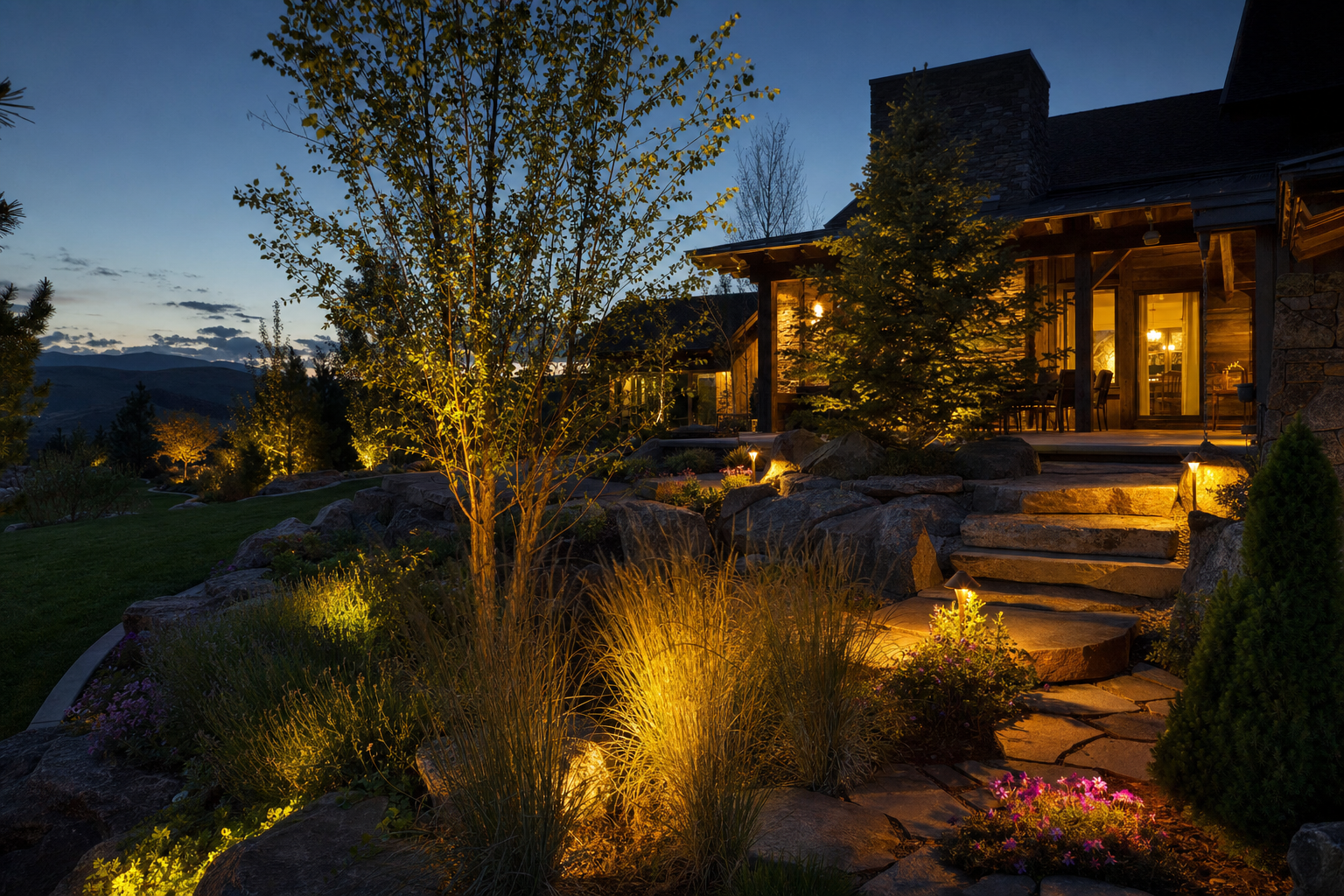
The term “outdoor lighting” covers a wide range of applications, and the installation process varies depending on what you are lighting and why. Path lighting along a paver walkway uses low-profile bollard or stake fixtures wired back to a central transformer. Uplighting for architectural features or mature trees uses directional fixtures buried flush with the ground or mounted at grade. Step lighting, which is particularly important on properties with outdoor steps or tiered retaining walls, uses recessed or surface-mounted fixtures integrated directly into the riser or cap.
All of these applications share the same backbone: a low-voltage transformer wired to 12-volt cable runs that branch out to individual fixture locations. Our team starts by mapping fixture locations during a site walkthrough, noting the function of each zone, the distance from the transformer, and any existing hardscape that affects how we route wire. We trench cable runs where needed, typically at a depth of six inches, and use waterproof connectors at every fixture junction. The transformer is mounted near an exterior outlet and programmed with a timer or photocell so the system activates automatically at dusk.
Fixture selection is where Reno’s climate enters the conversation directly. The UV index on the east side of the Sierra Nevada is consistently higher than coastal or midwestern cities at similar latitudes, and summer temperatures in neighborhoods like South Meadows or along the Truckee River corridor regularly push past 95 degrees Fahrenheit. Plastic fixture housings degrade faster here than manufacturers’ general ratings suggest. We default to brass, copper, and aluminum fixtures with UV-stable powder coatings because they hold up through the freeze-thaw cycles of Reno winters and the intense solar exposure of Reno summers without cracking, fading, or losing their seal.
How Does Outdoor Lighting Installation in Reno, NV Differ From a Standard Electrical Job?
Low-voltage landscape lighting operates at 12 volts rather than the 120 volts used in standard household wiring, which changes both the safety requirements and the installation approach. Most jurisdictions, including Reno, do not require an electrical permit for low-voltage landscape lighting systems because the voltage is too low to create a shock hazard under normal conditions. That said, the transformer itself connects to a standard 120-volt exterior outlet, and that connection needs to be handled correctly. If no exterior outlet exists in the right location, adding one does require a licensed electrician and a permit.
The design side of outdoor lighting also requires a different skill set than standard electrical work. Calculating the load on each transformer circuit, spacing fixtures to avoid hot spots or dark gaps, and choosing color temperatures that complement the materials in your outdoor space are decisions that affect how the finished system actually looks and performs. A paver patio, an outdoor kitchen, or an outdoor fireplace each respond differently to fixture placement and color temperature. We use 2700K to 3000K color temperatures for most residential projects because that warm white range complements natural stone and concrete pavers without washing out the textures that make those materials worth seeing at night.
If you are planning a larger outdoor project, lighting integrates most cleanly when it is designed alongside the hardscape rather than retrofitted afterward. Our design and rendering process includes lighting placement as part of the overall plan, which makes it easier to route conduit and wire runs before pavers are set or walls are built. Our post on how 3D landscape design makes a difference in Reno explains how that planning process works in more detail.
What Should You Expect During the Installation Process?
Most residential outdoor lighting installations in Reno take one to two days. Day one covers trenching, wire routing, and fixture placement. Day two, if needed, handles transformer programming, final fixture adjustments, and a nighttime walkthrough to confirm coverage and aim directional fixtures correctly. That nighttime walkthrough is not optional for us. Fixture aim looks different in daylight than it does after dark, and small adjustments at this stage prevent the kind of glare or shadow problems that are annoying to fix later.
Homeowners should expect some minor disturbance to the areas where we trench, though we keep cuts narrow and restore the surface as closely as possible. On properties with artificial turf, we route wire under the turf perimeter rather than cutting through the field, which keeps the installation clean. On properties with exposed decomposed granite or gravel, trenching is straightforward and the surface restoration is minimal.
After installation, the system requires very little maintenance. LED bulbs in quality fixtures typically last 50,000 hours or more, and the transformer’s timer or photocell handles daily operation automatically. We do recommend checking wire connections and fixture seals once a year, particularly after Reno’s freeze-thaw season in late winter, when ground movement can occasionally shift fixtures or stress connections.
How Do You Know When Your Yard Needs a Lighting System?
The clearest signal is that you stop using your outdoor space after dark, not because you want to, but because you cannot see where you are going. Unmarked steps, unlit walkways, and dark patio edges create real safety issues, particularly on properties with grade changes. If your yard includes steps or retaining walls that are invisible at night, that is a functional problem, not just an aesthetic one.
Beyond safety, lighting reveals the investment you have already made. A well-built paver patio or water feature looks different at night with the right fixtures aimed at it. If you have put work into your outdoor space and it disappears after 8 p.m., lighting is the straightforward fix. For homeowners who are still in the planning phase, our guide on finding the right landscape contractors in Reno covers what to look for before committing to any outdoor project.
Our outdoor lighting service page covers the fixture types and system options we work with, and we serve homeowners across Reno, Sparks, and Carson City. If you are ready to talk through what a system would look like for your specific yard, reach out to our team to schedule a site walkthrough.
In July, we do our final fixture adjustments after 8:30 p.m. when the sky is fully dark. That is the only way to know what the system actually looks like when you are out there using it.
Frequently Asked Questions
How long does outdoor lighting installation take in Reno, NV?
Most residential projects take one to two days. The first day covers trenching, wire routing, and fixture placement. The second day, if needed, handles transformer programming and a nighttime walkthrough to confirm fixture aim and coverage. Larger projects with multiple zones or complex hardscape integration may take an additional day.
Do I need a permit for outdoor lighting installation in Reno?
Low-voltage landscape lighting systems operating at 12 volts typically do not require a permit in Reno. However, if your project requires adding a new exterior 120-volt outlet to power the transformer, that portion of the work requires a licensed electrician and a standard electrical permit through the City of Reno.
What type of fixtures hold up best in Reno’s climate?
Brass, copper, and aluminum fixtures with UV-stable powder coatings perform best in Reno’s high desert environment. The combination of intense summer UV exposure and winter freeze-thaw cycles degrades plastic housings faster than manufacturers’ general ratings suggest. We avoid plastic-bodied fixtures on all Reno installations for this reason.
Can outdoor lighting be added to an existing paver patio or hardscape?
Yes. Retrofitting lighting onto an existing patio or walkway is a common project in Reno, particularly for homeowners who had hardscape installed without lighting and now want to use the space after dark. Wire runs are typically routed along paver edges or through narrow trenches in adjacent areas, minimizing disturbance to the existing surface.